
Guide to Gibson Wood Height Adjustable Saddles
Some Gibson height adjustable saddles from the mid-1960s and into the 1970s were made with rosewood instead of ceramic. Although these wood saddles appear to be the same as the earlier ceramic adjustable saddles and the later Tusq saddles, subtle differences do appear.
In this article we will discuss the Gibson rosewood adjustable saddle measurements versus other material types, whether or not you can replace one with a ceramic, Tusq or bone option, maintenance, and aftermarket wood options.
Note: A height adjustable saddle is different from a floating bridge, which is found on an archtop guitar. Please see the following link for more information on floating bridges – Floating Bridge Information.
Measurements
The original rosewood saddles often had an inverted U shape where the strings sat. Shifting from a wood saddle to the pyramid center line non-compensated, often found on ceramic, bone or Tusq options, might produce a very subtle string scale length difference that could have a subtle effect on intonation.
Wood saddles are often 1 to 2 taller than their ceramic, bone, or Tusq counterparts are, so you must measure your saddle’s maximum height before ordering a replacement. Although the saddles are adjustable, your guitar may still need the extra height, and so a taller wood saddle may be your only option.
Next, measure your saddle’s top radius. A rosewood saddle top radius might be 16 inches, whereas you may see 12 or 14 inch radii on other materials.
Additionally, measure your bass to treble height difference. This is often a subtle difference, and the saddles can be adjusted, but you must measure before ordering a replacement. Note that Tusq adjustable saddles have a 0.7 mm bass to treble height difference. We make all our Gibson-style adjustable saddles with a 0.7 mm bass to treble height difference.
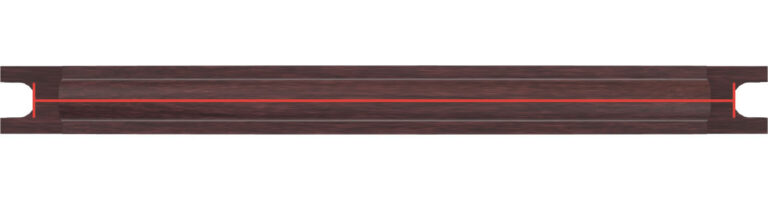
Finally, measure your wood saddle’s pole-to-pole distance, as shown in the image below. This is unlikely to be a problem, but you will see subtle differences among saddle types.
Maintenance
String Gouges
Aftermarket Wood Options
You will find some rosewood aftermarket adjustable saddles for purchase online. We offer three different versions – center line non-compensated, center line B compensated, and step compensated.
Center Line Non-Compensated
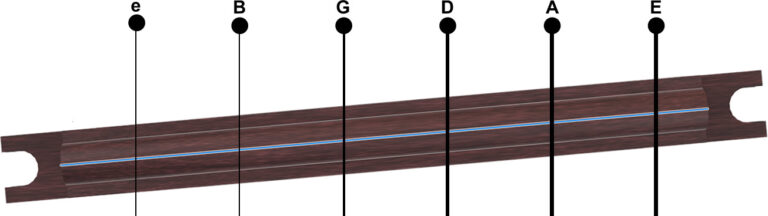
If you currently have the above saddle compensation pattern and are satisfied with your intonation, then please see our Adjustable Rosewood Saddle For Some Gibson Guitars – Center Line Non-Compensated listing.
Center Line B Compensated
We offer this aftermarket pattern, but this did not appear on original models. This pattern type is similar to the center line non-compensated saddle, but the B string will sit farther back toward the bridge pins and produce a longer scale length, as shown below.
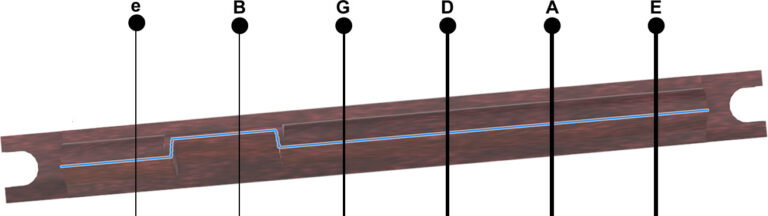
For guitars that currently have a center line non-compensated saddle, but a sharp B string, then consider this saddle type but note that this will not necessarily correct the B string from being sharp. It might assist, though, by lengthening the scale length. Please see our Adjustable Rosewood Saddle For Some Gibson Guitars – Center Line B Compensated listing.
Step Compensated
This is also an aftermarket saddle pattern option we offer. This compensation pattern is similar to the center line B compensated saddle, but with the A and bass E strings sitting progressively farther back toward the bridge pins, as shown in the below image.
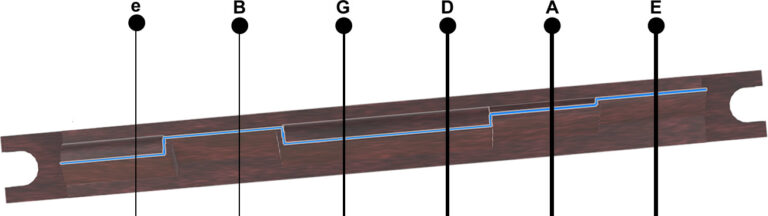
For guitars that currently have a center line non-compensated saddle, but with sharp B, A, and bass E strings, consider this pattern as a replacement. However, please note that while this pattern will lengthen the scale lengths slightly for those strings, it will not necessarily correct these strings from being sharp, but might help. Please see the following link to purchase this saddle type: Adjustable Rosewood Saddle For Some Gibson Guitars – Step Compensated.
Which Adjustable Saddle Does Your Guitar Need?
Are you still wondering which through saddle your acoustic guitar needs? Please contact us with all of the below information.
• Fretboard Radius
• Current Saddle Length, Top Radius, Maximum Height, Bass to Treble Height Difference, Thickness
• Guitar Saddle Slot Length, Thickness (if different from saddle specs)
• Current Saddle Compensation Pattern (please send a picture if you are not sure what type you have)
• String spacing at the bridge
We will respond within 48 hours.
Disclaimer: The guitar technical information on this site is provided for general information and educational purposes only and is not a substitute for professional guitar repair advice. The use or reliance of any information contained within this site is solely at your own risk. Always take personal safety precautions, including the use of a dust mask, ear protection, and eye protection.