
Guide to Acoustic Guitar Split Saddles
Although most commonly associated with Takamine Guitars or Lowden Guitars, split saddles have appeared on some models for other brands as well, including Avalon, Maton, Sobel, some Ibanez, and at least one Alvarez model that we know of, the Masterworks MD350.
Despite appearing on a number of different manufacturers’ models, there is no universal split saddle size, even for the same manufacturer, and even for models from the same series, e.g., there are currently three different split saddle sizes for the Takamine G Series, and two different sizes for the Takamine Pro Series, and none are interchangeable. Takamine has other split saddle sizes as well.
To make things even more difficult, many of the split saddle options for sale on the internet are blanks that have the correct radius, but thickness, length, height, and bass to treble height difference likely need some adjustment, the top needs profiling, and edges may need rounding. And with some Takamine split saddles, the bottom will either be flat, or notched to fit with an integrated pickup.
This article walks you through the steps to find the appropriate split saddle replacement for your acoustic guitar. The saddle sizes found online, even OEM parts, are often common starting points, not factory set heights that require no adjustment. Each guitar will have a slightly different neck angle, and so although the factory might set the twelfth fret action at a specified height, this can be achieved through a combination of adjusting the neck relief, nut slot height, or saddle height, resulting in different saddle sizes, even for the same guitar model from the factory.
If you are missing either or both pieces, then you must take your guitar to a qualified guitar technician. Trying to determine the maximum heights and bass to treble height differences needed for a new split saddle on your own will be difficult. You may not know whether the saddle pieces needs to be adjusted, or the neck relief, or the nut slots, or a combination of those. You must also ensure that the two saddle piece heights are similar to each other to ensure smooth playability.
Step One – Measure Current Saddle Thickness, Lengths, and Short/Tall Edge Heights
Split saddles will have a bass side piece for the four wound strings, and a treble side piece for the two plain strings. You will need to remove your current saddle pieces and measure the thickness, which is typically the same for both pieces, as well as the lengths, and the short and tall edge heights for both pieces as shown in the below image.
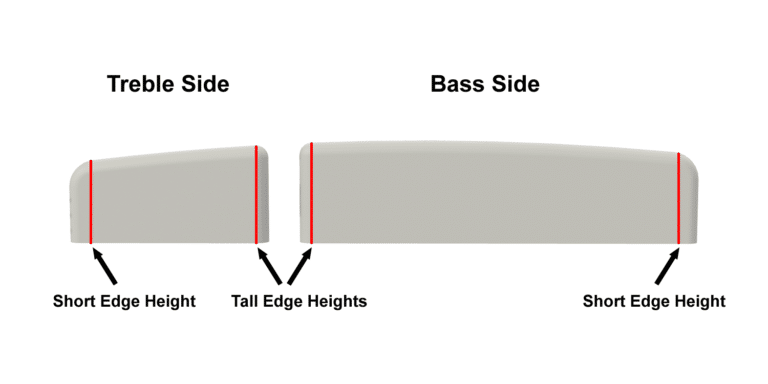
Note that the two short edge heights are unlikely to be the same. Guitar saddles are often made with the bass edge about 1.0 mm taller than the treble edge is, although this varies for each guitar. Please see our article on bass to treble edge height difference for more information. Additionally, the tall edge heights will typically differ slightly as shown in the below diagram.
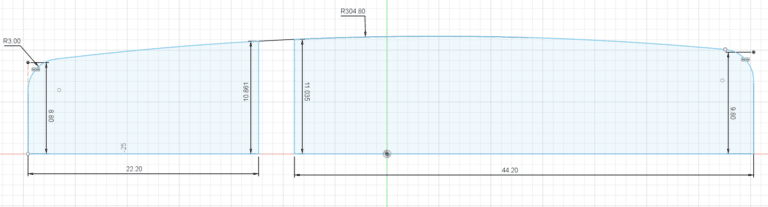
We also advise that you measure your bridge saddle slot lengths and thicknesses as these can vary subtly from your saddle’s. You may need to get a slightly longer and/or thicker split saddle.
Step Two – Measure Fretboard and Saddle Radii
Your saddle and fretboard radii should match as this will result in better playability and reduced buzzing. Please note that guitar builders will sometimes use a saddle that has a radius different from the fretboard’s. We advise that you measure both your fretboard radius, and then find a split saddle with an identical radius.
Step Three – Determine Top Profile
Although it might seem as though the top profile for split saddles is non-compensated and are thus the same, differences do appear. Similar to single piece non-compensated saddles, you will find that split saddles are typically either center line or forward line, as shown in the below images, which show split saddles from the back, or bridge pin side view.
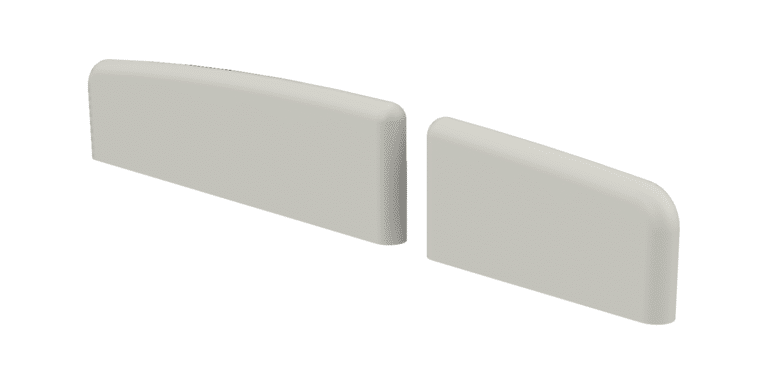
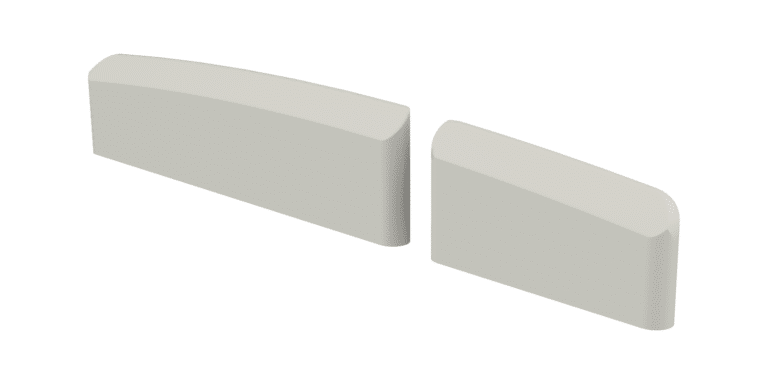
While this might not seem like much of a difference, replacing a center line saddle with a forward line saddle, or vice versa, can produce a scale length difference that can affect your intonation. Additionally, with forward line saddles, you must ensure that you have the correct handedness, as right- and left-handed saddles are not interchangeable.
Step Four – Determine Edge Type(s)
Guitar saddle edges are often rounded, as shown in the below images.
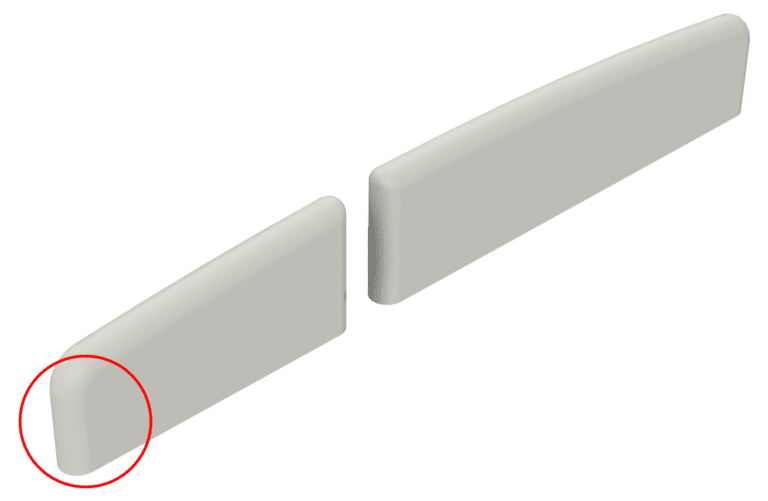

However, your split saddle might have flat edges, as in the below images.
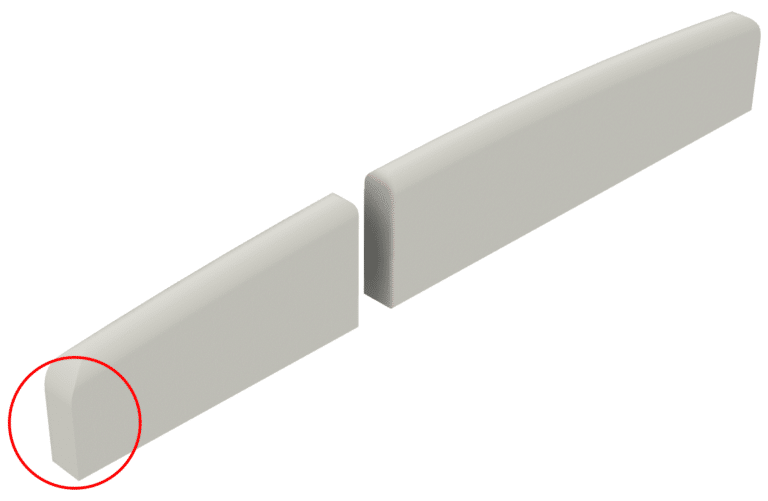

You might have a mix of round and flat edges as well, particularly if your split saddle was created by making a single piece saddle, then cutting it into two pieces. Some Takamine Pro Series split saddles will have round inside edges, but flat outside edges.
Step Five – Determine Corner Type (Optional)
Guitar saddle corners vary. Many guitarists are not concerned about saddle corners as they have no effect on tone or intonation. However, they can have a subtle effect on comfort if you rest your picking hand on or near the saddle, and can have a subtle effect on appearance. Also, because of the way split saddles are made, you may see two different corner types on the same piece. For more information, please see our article on guitar saddle corners.
Step Six – Find a Replacement
Finding a replacement split saddle will prove difficult as there are few available online. Below are some options, though, for various builders.
Takamine
As noted earlier, there are several different split saddle types for Takamine models, and not only must you measure your current saddle as described above, but also must determine whether you need a flat bottom or notched bottom for use with an integrated pickup. Try Addicted To Tone, Inc. or GuitarRepairParts.com, but note that bone split saddles from these companies are factory blanks that are the correct length and radius, but do not have profiled tops or rounded edges. If you have a Takamine G Series with an integrated pickup, then factory saddles are plastic. You can find bone options from Chris Alsop Guitar. However, we advise that you read the article at the following link first: hum problems.
Lowden
Lowden split saddle sizes will vary depending on year and model, so you must measure as described above. You can purchase a split saddle directly from the Lowden website, but note that these are forward line non-compensated saddles and so right- and left-handed options appear. Current Lowden split saddle replacements from the factory are 47.7 mm and 24.7 mm long, 2.8 mm thick and have rounded edges along with a 16 inch radius.
Ibanez
Finding the correct saddle for an Ibanez is always difficult as the company has over 100 different saddle types, including various split saddles. See our guide to finding an Ibanez acoustic guitar saddle for details.
Which Split Saddle Does Your Guitar Need?
Wondering which split saddle type and size your guitar requires? You can view our bone split saddle offerings, or contact us with all of the below information.
- Guitar Year, Series, Model
- Fretboard Radius
- Current Saddle Lengths, Thicknesses – Must be measured with a caliper
- Bass Side Short and Tall Edge Heights
- Treble Side Short and Tall Edge Heights
- Bridge Saddle Slot Lengths and Thicknesses (if different from saddle specs)
- Current Saddle Top Profile (Please send a picture if you are not sure which type you have)
- Edge Type(s) – Round or Flat
We will respond within 48 hours.
Disclaimer: The guitar technical information on this site is provided for general information and educational purposes only and is not a substitute for professional guitar repair advice. The use or reliance of any information contained within this site is solely at your own risk. Always take personal safety precautions, including the use of a dust mask, ear protection, and eye protection.