
Guide to Gibson Mark Series Saddles
Gibson Mark Series guitar saddles are distinct from any other saddle type, and also quite large, making finding a replacement a difficult task. This guide provides steps on how to find an appropriate replacement.
Note: If your Gibson Mark is missing a saddle, then we advise that you take your guitar to a professional guitar technician. Please see the What if My Acoustic Guitar Is Missing the Saddle? section at our What Acoustic Guitar Saddle Height Do I Need? article.
Step One – Measure Fretboard Radius
We have seen varying radii listed for Gibson Mark models and so you will need to measure your fretboard radius, or try contacting Gibson with your serial number. Note that your current saddle’s radius, even if it’s a factory Gibson Mark saddle, may differ from your fretboard’s. In our experience, people typically prefer the playability of matching fretboard and saddle radii.
Step Two – Determine Saddle Type
There was no single saddle type for the Gibson Mark models. Additionally, your guitar may not have the original bridge and/or saddle.
There was, however, a common, but not standard, saddle type originally used on many Mark models. Depending on your guitar’s year and model, it may or may not have this common saddle type.
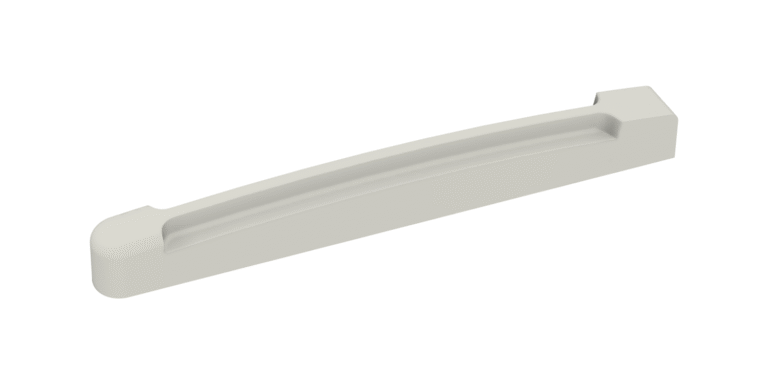
The common saddles were long (around 80 mm) and thick (6.35 mm or 1/4 inch). The Mark models came with three different saddle heights – H, N, or L – presumably for High, Normal, Low. The saddles were center line non-compensated with routed fronts and backs, such as in the image below.
Step Three – Determine Saddle Material
The common saddles were made of plastic, but we’ve seen reports of bone and ebony saddles as well, although it’s not clear whether these were factory saddles or not.
Step Four – Measure Saddle, Saddle Slot, String Spacing
You must measure both your current saddle and the bridge saddle slot. Although Gibson Mark models were often made with quarter inch thick saddle slots, wood will shift with humidity, and so you may need a slightly thinner or thicker saddle. You also need to confirm saddle slot length and compare to a saddle replacement’s specs.
Although Gibson often provided three separate saddles with three separate heights – H, N, L – even if your saddle is an original, it likely has been adjusted at some point, particularly the bass to treble height difference. As such you will need to measure your current saddle’s length, thickness, maximum height, bass to treble height difference, and top radius, and then compare to the specs for the replacement saddle you plan to buy.
You must also measure your bridge string spacing before getting a replacement saddle. The Gibson Mark Series saddles you may find will often only work for narrow bridge string spacings, such as 2 1/8 inches (54 mm). Or, if you are shifting to a compensated saddle, need to ensure that the strings line up with the pattern.
Step Five – Determine Current and Desired Compensation Pattern
Your Gibson Mark’s original saddle was likely center line non-compensated. If you are satisfied with your intonation, then we advise that you purchase a center line non-compensated replacement.
If there are specific intonation issues that you wish to address, consider the compensated options listed later in this article, but before doing so, you must determine how those patterns will affect your intonation. Increased compensation does not necessarily produce improved intonation. Saddle compensation will have an effect on intonation, but this could have a positive or negative effect depending on your specific guitar. If you are not sure about this, please contact a guitar technician.
Center Line Non-Compensated
This saddle type is similar to the common saddle described above.
Let’s view an image of this pattern looking down on the saddle top. The saddle is at a five degree angle, which itself serves as a form of compensation. You can see where each string sits on the saddle top, but this can vary depending on bridge string spacing.
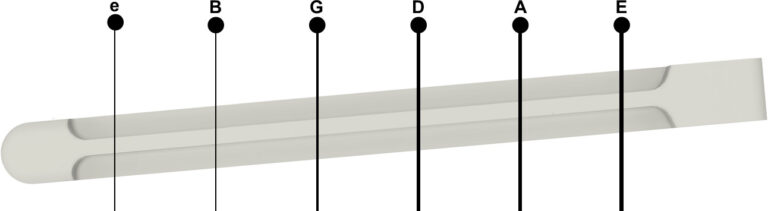
If you currently have this type of compensation pattern and are satisfied with your intonation, then please see this link Gibson Mark-Style Center Line Non-Compensated Saddle to purchase. Note that this has a 9.5 mm maximum height, as do all of our Gibson Mark style saddles. Please note that we make these similar to the original Gibson saddles with the 90 degree angles on either side of where the strings rest on the saddle top. We do this because customers often want saddles that closely match their original factory parts.
However, some customers prefer not having the sharp angle on the back side where the strings go down toward the bridge pin holes. This can cause string grooves and string breakage. Please see the following link and scroll to the bottom for more information on this: Saddle Angle and Compensation.
As such, for these customers we also offer this saddle with a rounded back as shown in the below image.
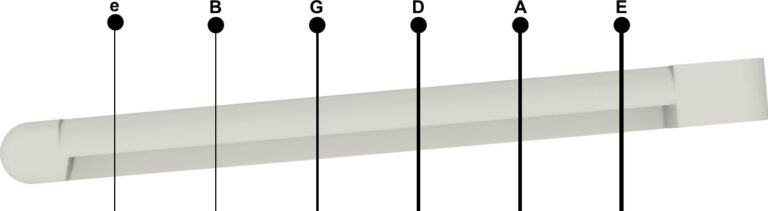
To purchase this saddle, please see the following link: Gibson Mark-Style Saddle – Rounded Back Non-Compensated.
Center Line B Compensated
This is a second aftermarket pattern that we offer in bone. This pattern is similar to the rounded back center line non-compensated saddle, however, the B string sits farther back toward the bridge pins, as shown in the below image.
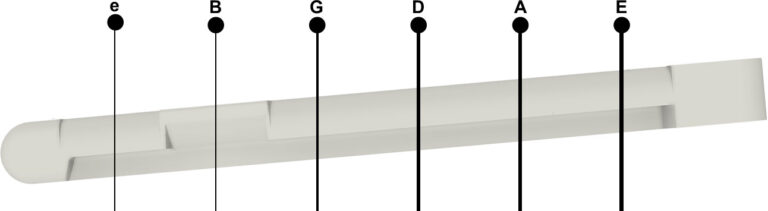
If you currently have a center line non-compensated saddle, but your B string is sharp, consider this pattern. However, note that this will not necessarily correct your B string being sharp, but may help by slightly lengthening the scale length. Please see the following link to purchase this saddle type: Gibson Mark-Style Saddle – Center Line B Compensated.
Step Compensated
This is another aftermarket saddle pattern that we offer in bone. This pattern is similar to the center line B compensated saddle, but the A and bass E strings sit progressively farther back toward the bridge pins, as shown in the below image.
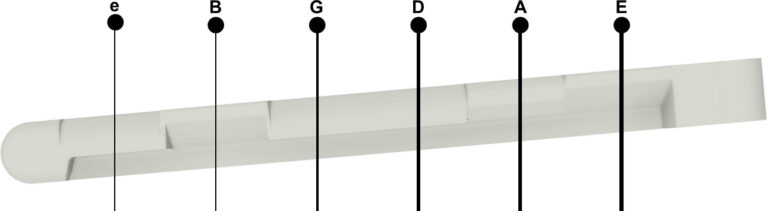
If you currently have a center line non-compensated saddle, but your B, A, and bass E strings are sharp, consider this saddle pattern type. Please note that this will not necessarily correct these strings from being sharp, but might help by lengthening the scale lengths slightly. Please see the following link to purchase this saddle type: Gibson Mark-Style Saddle – Step Compensated.
What Saddle Does Your Gibson Mark Series Guitar Need?
Still wondering which saddle your guitar needs? Please send us all of the following information.
• Fretboard Radius
• Current Saddle Length, Maximum Height, Thickness – Must be measured with a caliper
• Bass to Treble Height Difference
• Guitar Saddle Slot Length, Thickness (if different from saddle specs) – Must be measured with a caliper
• String spacing at the bridge
• Current and Desired Saddle Compensation Pattern
Disclaimer: The guitar technical information on this site is provided for general information and educational purposes only and is not a substitute for professional guitar repair advice. The use or reliance of any information contained within this site is solely at your own risk. Always take personal safety precautions, including the use of a dust mask, ear protection, and eye protection.