
Bone Saddle on a Yamaha JR2 Travel Guitar
The Yamaha JR2 provides a decent budget guitar for those looking for a small guitar for children, small adults, or a travel guitar. Compared to the Yamaha JR1 model, we found that the JR2 had a subtly richer and warmer tone worth the extra cost. Presumably this results from the wood differences. Yamaha uses Mahogany Ultra-Thin Film back and sides on the JR2 model, whereas the JR1 has Meranti back and sides.
The JR2 provides enough volume for personal playing, but would be drowned out in a group setting. Furthermore, it has little headroom, so an aggressive or dynamic attack won’t work on this guitar. We found that a consistent light or medium attack worked just fine, though.
Yamaha produces good overall construction, but with minor construction flaws that you would expect on an instrument at this price point.
Factory Set Up
The factory set up was decent overall. Most of the strings were properly seated at the nut, and not buried or pinched, which can result in a muted tone and/or poor playability. However, the exception was the treble E string, which was set quite low – please see the below picture.
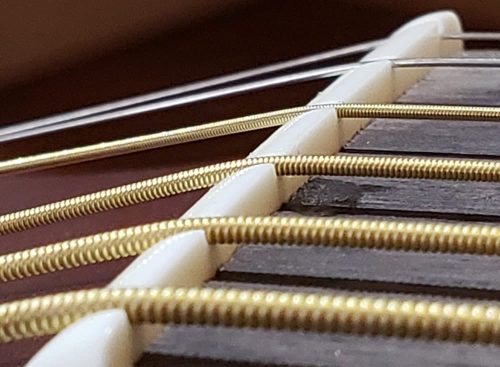
The factory twelfth fret action measured at 6/64 and 5/64 for the bass E and treble E strings, respectively. Intonation was OK for most strings, but a bit off for the bass E string, particularly when forming chords. The factory saddle was Yamaha Part Number QA079000, a center line non-compensated resin saddle with a 74.5 mm length and max height of 8 mm. The saddle had a 2.85 mm thickness, whereas the saddle slot thickness measured a touch over 3.0 mm. This resulted in a subtle forward lean and a visible gap on the back side.
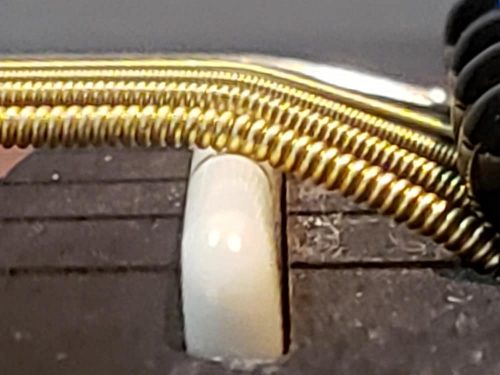
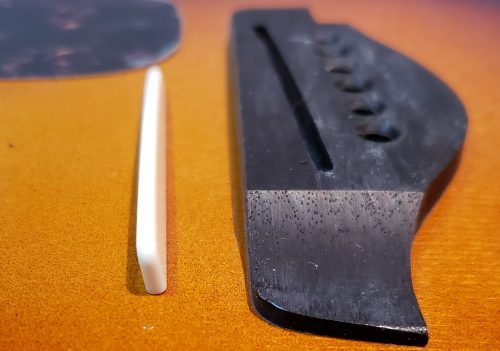
When we took the saddle out, we found that it in addition to being too thin for the bridge slot, was also not level on the bottom, resulting in poor contact with the bridge.
Bone Saddle Replacement
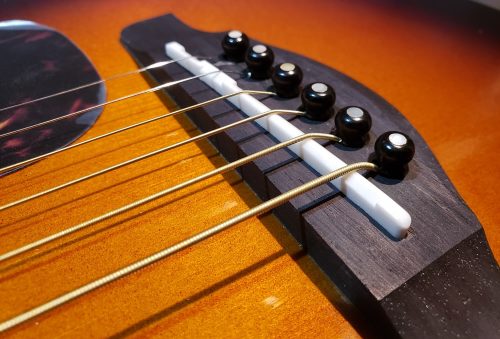
We replaced the factory saddle with one of our bone saddles designed to fit many Yamaha steel-string guitars. Our saddle is slightly larger than the factory saddle, so we made the minor adjustments to produce a snug fit. As a result, this produced a subtly fuller tone and improved intonation for the bass E string, which was apparently a combination of eliminating the forward saddle lean and saddle compensation.
Although the compensated saddle worked better for this particular guitar, we typically advise replacing a non-compensated saddle with a similar non-compensated saddle. Yamaha has often used a very sharp bridge saddle slot angle rather than a compensated saddle. Placing a compensated saddle on a guitar designed to use a non-compensated saddle can have a negative impact on intonation. Increased compensation does not necessarily equal improved intonation. You should only use a compensated saddle in place of a non-compensated saddle if there are specific intonation issues you with to address.
Questions?
Do you have questions about which saddle would work best for your Yamaha guitar? Please see our Guide to Yamaha Acoustic Saddles for more information.
Disclaimer: The guitar technical information on this site is provided for general information and educational purposes only and is not a substitute for professional guitar repair advice. The use or reliance of any information contained within this site is solely at your own risk. Always take personal safety precautions, including the use of a dust mask, ear protection, and eye protection.