
Which Saddle for Your Taylor GS Mini?
There is no single saddle size for a Taylor GS Mini. Saddle type and size will depend on your guitar’s model and year. The GS Mini was first introduced in 2010 and various versions have appeared, including Mahogany, Maple, Rosewood Sapele, and Koa back and sides models, as well models with or without a pickup.
Your GS Mini may have a forward line B compensated or a wave compensated saddle. Please compare your current saddle’s compensation pattern to the images below. If you’re unable to tell which compensation pattern that your saddle has, please contact us and we can assist.
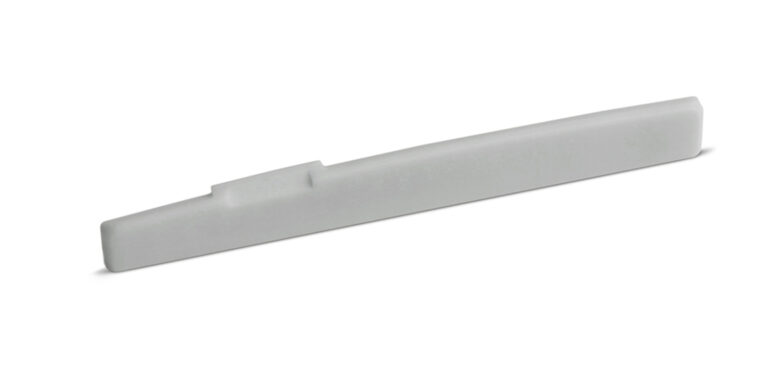
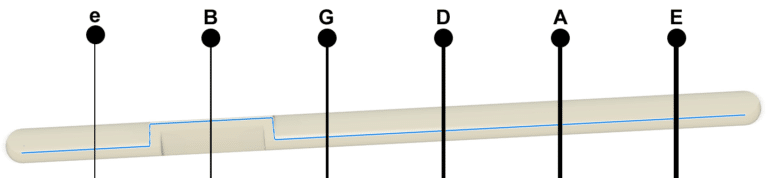
Forward Line B Compensated Saddle
This saddle compensation pattern puts all strings at the front of the saddle, toward the soundhole, except the B string, which sits further away from the soundhole, toward the bridge.
Slanted Bass Wave Compensated Saddle
The slanted bass wave compensation saddle has flowing lines for a wavelike appearance. Similar to the forward line B compensated saddle, the treble E and G strings will appear forward, with the B compensated to the back. However, with the wave compensated saddle, a progressive backward slant appears for the D, A, and E strings.
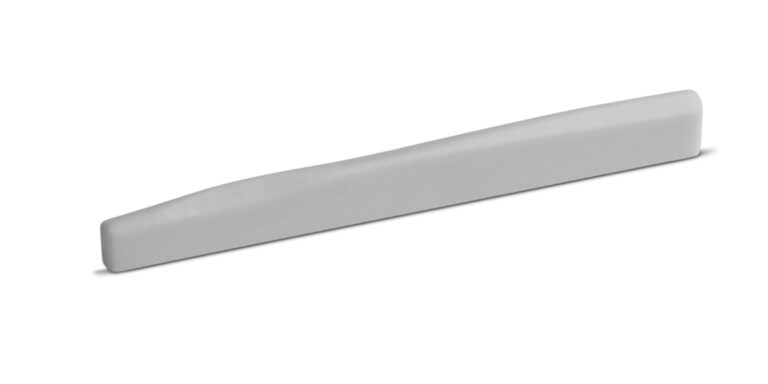
You might be tempted to replace your forward line B compensated saddle with a wave compensated saddle. However, we advise against this. First, the wave compensated saddle is a bit shorter in length than the forward line B compensated saddle is.
Second, additional compensation for the bass strings does not necessarily produce better intonation, and somewhat ironically, can negatively affect your intonation. Guitar builders factor in bridge saddle slot angle, scale length, and string diameter to determine saddle compensation pattern. Putting a wave compensated saddle with the additional bass compensation could lengthen your bass strings too much and negatively affect your intonation.
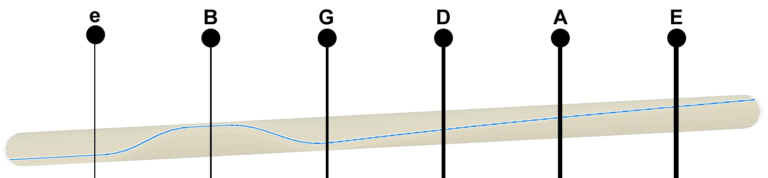
The treble E, B, and G strings sit in a similar position. However, there’s progressive backward compensation for the D, A, and bass E strings. This increased string length is not necessarily an improvement and could have a negative affect on your intonation.
Remove Current Saddle and Measure
Once you have determined which compensation pattern, you will need to measure your current saddle’s length, maximum height, thickness, and bass to treble height difference. You can remove your current saddle without completely removing the strings with the tips at the following link: Remove Acoustic Guitar Saddle.
The saddle sizes that we offer are common starting points, not factory set heights that require no adjustment. Each guitar will have a slightly different neck angle, and so although the factory might set the twelfth fret action at a specified height, this can be achieved through a combination of adjusting the neck relief, nut slot height, or saddle height, resulting in different saddle sizes for different guitars, even from the factory.
Note: If your Taylor GS Mini has an ES2 pickup, then you must adjust the pickup sensors behind the saddle for both saddle removal and installation. Please see the Pickup Adjustments section at the Taylor ES2 Guide for more information.
Once you have the specs for your current saddle, please visit our saddle offerings for Taylor Guitars for various options.
Bleached or Unbleached Bone?
Bleached bone produces a somewhat consistent color and works better for newer guitars to match the look. Unbleached bone is an often preferred for older guitars to match the look. Unbleached bone has a yellowish-brown color that is inconsistent not only from saddle to saddle, but often within an individual saddle as well. Unbleached bone is a slightly harder material and is a bit more difficult to work with, but some people prefer the tone, which they describe as slightly fuller.
If you have any other Taylor guitar models, please view our article on How to Find the Right Saddle for Your Taylor Guitar for more information.
Disclaimer: The guitar technical information on this site is provided for general information and educational purposes only and is not a substitute for professional guitar repair advice. The use or reliance of any information contained within this site is solely at your own risk. Always take personal safety precautions, including the use of a dust mask, ear protection, and eye protection.